
Outlook
Part of How to build a podcast SEO outlook that survives platform change
Scoring podcast SEO risks with a practical rubric
A practical podcast SEO risk framework for teams: build scenarios, score likelihood, impact and evidence, set triggers, and plan reviews.
What to take away
- Decide which risks you will score, then build a small set of scenarios (base, upside, downside).
- Attach a trigger that tells you when to revisit the plan.
- Score each scenario on likelihood, impact and evidence quality; weak evidence should lower your confidence, not your ambition.
- Set a review date that follows a real data release, so you are not guessing when the picture changes.
- Keep the scoring visible to the team, because a scenario nobody can audit is a scenario nobody will act on.
Why undated podcast SEO risk scenarios go wrong
Most risk work fails at the sourcing stage. A team writes down "discovery could fall" or "platform changes could hurt US" and treats that as analysis. It is not. A scenario earns its place only when you can point to the source, the date and the rule or dataset it came from.
That matters because podcast discovery sits across several systems at once: platform features, advertising rules, measurement conventions and listener behaviour. If any one of those shifts, your ranking assumptions shift with it. You can see the wider picture in our podcast SEO trends and outlook for England in 2027, which sets the context this risk work sits inside.
Check that page for a named publisher and release date before you rely on it. Ofcom's Media Nations report, published each summer, is one UK example.
Name the source before you score the risk
A useful discipline is to write the citation first. If you cannot cite it, you cannot score it. For audience-side assumptions, RAJAR publishes its RAJAR release dates in advance, which lets you line up a review meeting with the next data drop instead of inventing a date.
On the product side, features change how episodes are consumed and linked. Apple documents using chapters on Apple Podcasts, which is a concrete example of a feature that affects both user experience and how a show's content can be surfaced.
For paid promotion risk, the platform's own guidance is the place to start. A podcast promotion bought through a social platform can fail if the ad rule changes. LinkedIn's LinkedIn ad tips and best practices set out how campaigns should be structured and measured, and a change there can invalidate a promotional scenario that drives podcast discovery.
If your scenario depends on trend numbers rather than rules, check podcast SEO 2027 trends: data and sources for a named publisher and release date before you build the model, because the provenance of those figures determines how much weight they can carry.
A rubric for scoring each scenario
Score every scenario on the same three axes. Keep the scale small so the team actually uses it. Evidence quality is the axis most teams skip, and it is the one that stops a hunch being presented as a forecast.
Scenario scoring rubric
Axis
- Likelihood
- Remote, no precedent
- Impact
- Minor reporting noise
- Evidence quality
- Assumption only
Score 1
- Likelihood
- Plausible in window
- Impact
- Changes channel mix
- Evidence quality
- Named source, undated
Score 3
- Likelihood
- Visible in current data
- Impact
- Threatens core discovery
- Evidence quality
- Named source with a date
Score 5
- Likelihood
- Impact
- Evidence quality
1
- Likelihood
- Remote, no recent precedent
- Impact
- Minor reporting noise
- Evidence quality
- Assumption only
3
- Likelihood
- Plausible within the planning window
- Impact
- Changes channel mix or budget
- Evidence quality
- Named source, undated
5
- Likelihood
- Already visible in current data
- Impact
- Threatens core discovery
- Evidence quality
- Named source with a date
Multiply the three scores to rank scenarios. A high-impact scenario built on an assumption should sit below a moderate one backed by a dated release. For example, a show spending £600 a month on promotion should treat a documented ad-rule change as higher priority than a rumoured algorithm shift.
Worked example
Field / Entry
- Scenario
- RAJAR shows a fall in audio reach among 15-24s in England
- Source
- RAJAR Q1 2025 release
- Date
- The Q1 2025 date listed on RAJAR's release dates page
- Likelihood (1-5)
- 2
- Impact (1-5)
- 5
- Evidence (1-5)
- 5
- Rank
- 50
This is an illustrative scenario, not a forecast. The rank is likelihood multiplied by impact multiplied by evidence: 2 x 5 x 5 = 50.
Fill-in template
Field / Your entry
- Source
- Date
- Trigger
- Owner
- Likelihood (1-5)
- Impact (1-5)
- Evidence (1-5)
- Rank (multiply)
Setting the trigger
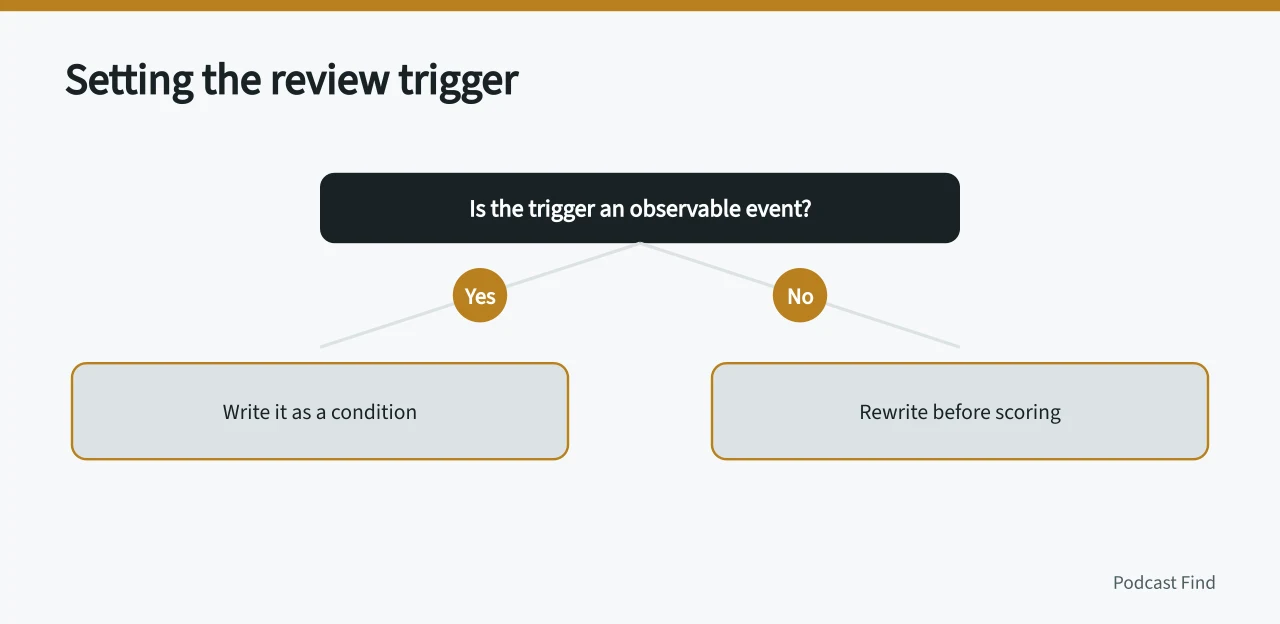
A trigger is the observable event that tells you to reopen the plan. Write it as a condition, not a feeling: a named release date passing, a rule page updating, or a measured metric moving beyond a set band.
Choosing the review window
Use RAJAR's published release dates. The quarterly releases typically fall in February, May, August and late October or early November. For England teams, set four reviews in the working week after each RAJAR release. Monthly reviews are only worth it if you are actively buying media and need to react to rule changes quickly.
Next steps for the scenario list
Pick five scenarios, no more. Use the template above to record each one, then diarise the review against a real release date rather than a convenient meeting slot.
Revisit the rubric when a source changes, not on a fixed calendar alone. The value of this work is that it tells you when to look again, and why.
Common questions
How many scenarios should we score?
Five is usually enough for a single show or portfolio. More than that and the team stops maintaining the scores, which defeats the purpose.
Can we score risks without dated sources?
You can, but label them as assumptions and CAP their evidence score at 2. That keeps them visible without letting them drive budget decisions.
When should the review happen?
Line it up with a data release or a known rule-change window. A review scheduled against nothing tends to produce nothing.
Who owns the scenario list?
One named person, not a committee. They maintain the sources, the dates and the triggers, and they call the review.